 by Sylvia Mendoza
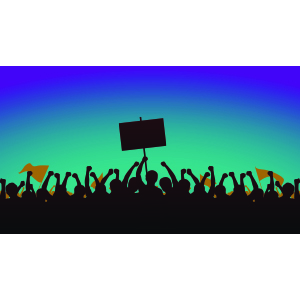
The United States was born out of protest. Remember the Boston Tea Party? That was a protest.
The First Amendment to the U.S. Constitution states: “Congress shall make no law respecting an establishment of religion or prohibiting the free exercise thereof; or abridging the freedom of speech, or of the press; or the right of the people peaceably to assemble, and to petition the Government for a redress of grievances.”
The right to peacefully protest originates from the “right of the people peaceably to assemble” clause within the First Amendment. This means that citizens can come together as a group to speak out for a specific cause or against an injustice, demanding change.
Right to protest not absolute
While the U.S. Constitution protects the right to protest, it does not protect acts of civil disobedience. The American Civil Liberties Union defines civil disobedience as “peaceful but unlawful activity in the form of protest.” Examples of civil disobedience include sit-ins, popular during the Civil Rights Movement, or blocking access to private property or private businesses.
The government can also enforce reasonable “time, place and manner” regulations for protests. For example, protesters are restricted to public spaces, such as sidewalks and public parks but are prohibited from protesting on private property. In addition, cities or municipalities can require permits for large groups or rallies. The government can also restrict noise levels, which could prohibit a protest from being held late at night.
“You can certainly go out on the sidewalk and engage in political discussion, but that doesn’t mean that you can just spontaneously organize a demonstration of 1,000 people and walk down Fifth Avenue in the middle of the day,” says Thomas Healy, a professor at Seton Hall Law School and a constitutional law expert. “The government is allowed to regulate when and how you demonstrate in a public forum, and so most cities have permitting requirements. As long as they’re not discriminating against the protesters because of the kind of speech they want to engage in, those kinds of permitting systems are fine.”
What the government can’t restrict is political speech even if that speech is controversial or may cause unrest. For example, in the 1978 case of National Socialist Party of America v. Village of Skokie, the U.S. Supreme Court affirmed the Supreme Court of Illinois’ ruling which upheld the neo-Nazi group’s right to march in Skokie, Illinois, a largely Jewish community.
In its ruling, the Supreme Court of Illinois stated, “Public expression of ideas may not be prohibited merely because the ideas are themselves offensive to some of their hearers.”
What can go wrong?
DeRay Mckesson, a civil rights activist, organized a 2016 Black Lives Matter protest in Baton Rouge, Louisiana. During the protest, a police officer was struck by an object that a protestor threw. The police officer sued Mckesson, citing that the protest organizer is responsible for the behavior of the protestors and can be held liable for negligence when criminal actions are committed by a protester.
In Mckesson v. Doe, the officer said Mckesson “should have known” an assault could occur. Mckesson sought First Amendment protections and in September 2017 the U.S. District Court for the Middle District of Louisiana dismissed the case. Chief Judge Brian A. Jackson wrote, “Mckesson cannot be held liable for the conduct of others with whom he associated.”
However, in December 2019, the U.S. Court of Appeals for the Fifth Circuit reversed the lower court’s dismissal.
“By ignoring the foreseeable risk of violence that his actions created, Mckesson failed to exercise reasonable care in conducting his demonstration,” wrote Judge E. Grady Jolly for the majority of the Fifth Circuit. “Mckesson owed Doe a duty not to negligently precipitate the crime of a third party. And a jury could plausibly find that a violent confrontation with a police officer was a foreseeable effect of negligently directing a protest.”
Mckesson appealed to the U.S. Supreme Court. In April 2024, the Court declined to hear the case; however, in the Court’s denial, Justice Sonia Sotomayor pointed to the 2023 U.S. Supreme Court decision in Counterman v. Colorado. Justice Sotomayor wrote, “The Court explained that ‘the First Amendment precludes punishment [for incitement], whether civil or criminal, unless the speaker’s words were “intended” (not just likely) to produce imminent disorder.’”
In light of the Court’s decision in Counterman, the U.S. District Court for the Middle District of Louisiana reheard the case and ruled in Mckesson’s favor, dismissing the lawsuit with prejudice, which means that the plaintiff in the case could not file again.
Professor Healy explains how difficult it is to show that a person intended to incite imminent unlawful conduct.
“If a speaker says, ‘We shouldn’t take this anymore,’ and then students rush the chancellor’s office, the speaker can always make the argument that, ‘Look, I didn’t intend for them to storm the building. I just said, we can’t take this anymore. But that wasn’t my intent.’ The government would have to prove that that was the intent, which can be difficult,” Professor Healy says.
History of college protests
The right to peacefully protest also extends to students on college campuses. In fact, one of the most well-known protests—the Free Speech Movement—started in 1964 on the University of California’s Berkeley Campus. The students there protested the university’s restrictions on political speech and activities on campus.
“Students, who were also involved in the Civil Rights Movement, challenged those rules, engaged in civil disobedience and nonviolent direct action by occupying a campus building,” explains Professor Healy. “They were arrested, continued their demonstrations in favor of free speech for several months until ultimately, the university backed down and opened up campus spaces for political speech and discussion.”
Until the Free Speech Movement, colleges and universities restricted political speech on campus. Today, public universities and colleges do not have the right to dictate which topics can be protested, but students must adhere to campus regulations. For example, students can protest on campus, but not while in class.
Providing more protection
The Free Speech Movement is a practice rather than a legal rule, Professor Healy says, and public universities have an obligation to allow public expression for any individual or group. The same does not apply to private universities because they are allowed to censor speech. However, most private universities express a commitment to free speech and enact policies to protect it.
The state supreme courts in six states—California, Colorado, Massachusetts, New Jersey, Oregon and Washington—have issued rulings that broaden free speech protection on certain types of private property, specifically shopping malls. In terms of providing more protection to students at private universities and colleges, California and New Jersey lead the way. California enacted the Leonard Law in 1992.
“The Leonard Law basically says that private universities in California have to respect the free speech rights of their students as if they were public universities,” Professor Healy says.
In the Garden State, the New Jersey Supreme Court ruled in the 1980 case of State v. Schmid that the New Jersey State Constitution’s guarantee of free speech is broader than what is provided in the U.S. Constitution’s First Amendment.
The case involved Chris Schmid who was arrested in 1978 for trespassing on the Princeton University campus while passing out political literature. Schmid, who was not a student at Princeton, was convicted of criminal trespass and fined $15.
The New Jersey Supreme Court unanimously reversed Schmid’s conviction, holding that under the state’s constitution an individual’s right to free expression on private property—in this case Princeton University—could not be unreasonably restricted. In its decision, the New Jersey Supreme Court noted the negative phrasing of the First Amendment in the U.S. Constitution—“Congress shall make no law…” compared to the positive phrasing in the New Jersey State Constitution. Found in Article 1, paragraph 6, the New Jersey State Constitution states, “Every person may freely speak, write and publish his sentiments on all subjects.” In addition, Article 1, paragraph 18, in the state’s constitution says, “The people have the right freely to assemble together, to consult for the common good, to make known their opinions to their representatives, and to petition for redress of grievances.”
The right to protest continues to provide a forum for diverse perspectives on college campuses across the country.
“Students are on college campuses to debate, exchange ideas and to learn how to participate in a democracy,” says Professor Healy. “One of the important lessons that came out of the Free Speech Movement is that universities, whether they’re public or private, make a serious mistake when they try to restrict the ability of students to engage.”
Discussion Questions
- If you have participated in a peaceful protest, explain what compelled you to participate. If you’ve never participated in a protest, what issue might prompt you to do so? Explain your answer.
- Do you agree or disagree with the outcome in the Mckesson v. Doe case? Explain your answer.
- How do you feel about protests on college campuses? What value, if any, do you think they provide? Explain your answer.
Glossary Words
affirm—to uphold, approve or confirm.
appealed—when a decision from a lower court is reviewed by a higher court.
appellate—dealing with applications for a court decision to be reversed.
civil disobedience—refusal to comply with certain laws as a peaceful form of protest.
dismissed—the termination of a lawsuit, resulting in no liability for a civil defendant or no conviction for a criminal defendant.
negligence—the failure to use the care that a reasonable person would use.
plaintiff—in a civil action, the person or persons bringing the lawsuit against another person or entity (the defendant).
reverse—to void or change a decision by a lower court.
This article originally appeared in the winter 2026 edition of Respect, NJSBF’s diversity and inclusion newsletter.