
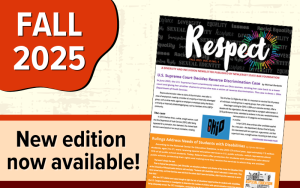
 Respect’s fall 2025 issue features articles on reverse discrimination, U.S. Supreme Court special education rulings, and an update on abortion laws three years after the Court’s Dobbs decision. A PDF of Respect’s fall 2025 edition can be downloaded or individual articles can be read and printed from Respect’s blog, The Rundown.
Any questions, contact the editor of Respect, Jodi L. Miller. She can be reached via email at jmiller@njsbf.org.
Here are the headlines from the Fall 2025 Edition:
U.S. Supreme Court Decides Reverse Discrimination Case
In June 2025, the U.S. Supreme Court unanimously sided with an Ohio woman, sending her case back to a lower court and giving her another chance to prove she was a victim of reverse discrimination. The case is Ames v. Ohio Department of Youth Services.
Reverse discrimination refers to claims of discrimination, most often in areas of employment, made by a member of a majority or historically advantaged group, such as white males, against an employer or employee policy that favors a minority or historically disadvantaged group, such as members of the LGBTQ+ community. READ MORE
Rulings Address Needs of Students with Disabilities
According to the National Center for Education Statistics, in the 2022-23 school year, approximately 7.5 million students, ages 3 to 21, were receiving special education services in U.S. public schools—which represents about 15% of all public school students. Today, federal laws offer protection for students with disabilities who attend public schools, protecting their rights and making sure they receive the services to which they are entitled.
That wasn’t always the case.
Prior to federal law protections, Jack Schneider, an education professor and director of the Center for Education Policy at the University of Massachusetts Amherst, told neaToday, “Students with disabilities weren’t educated in most cases. They were turned away, and their families were told that the school didn’t have the facilities, didn’t have the resources to serve their kids.” READ MORE
Abortion Rights Three Years After Dobbs
The U.S. Supreme Court’s June 2022 decision in Dobbs v. Jackson Women’s Health Organization stripped away constitutional protections for abortion, a medical procedure to intentionally end a pregnancy. The Dobbs decision overturned the Court’s ruling in the landmark 1973 Roe v. Wade case, which had made abortion legal across all 50 states.
To be clear, the Court’s decision in Dobbs did not make abortion illegal. It simply left the legality of the procedure up to the individual states. Thirteen states had “trigger laws” prepared so that if Roe v. Wade were to be overturned, laws that either banned the procedure outright or restricted abortion would automatically be put in place.
The result in the aftermath of the Court’s Dobb’s decision, has been a hodgepodge of differing rules and restrictions regarding whether—or in what cases—abortion is allowed across the nation, with many of these rulings continually shifting as they are challenged in court. READ MORE
Like a Subscription?
If you would like to be notified when new issues of Respect have been published, sign up for a digital subscription. If you would like a FREE print subscription, you can subscribe using our Publication Order Form. You’ll be sent the last published issue and when new issues are printed, you’ll receive those as well. Please order as many as you need for your students.