
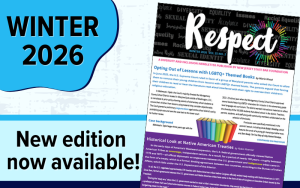
 Respect’s winter 2026 issue features articles on opting out of LGBTQ+ themed books, Native American treaties, and the right to protest. A PDF of Respect’s winter 2026 edition can be downloaded or individual articles can be read and printed from Respect’s blog, The Rundown.
Any questions, contact the editor of Respect, Jodi L. Miller. She can be reached via email at jmiller@njsbf.org.
Here are the headlines from the Winter 2026 Edition:
Opting Out of Lessons with LGBTQ+ Themed Books
In June 2025, the U.S. Supreme Court ruled in favor of a group of Maryland parents who asked the Court to allow them to remove their young children from lessons with LGBTQ+ themed books. The parents argued that forcing their children to read or hear the literature read aloud interfered with their right to oversee their children’s religious education.
In Mahmoud v. Taylor, the Court’s majority directed the Montgomery County School District, located in Maryland just outside of Washington, D.C., to reinstitute its prior policy allowing parents of elementary school students to excuse their children from lessons using material they consider objectionable. The Court granted a preliminary injunction against the school district’s policy prohibiting opt-outs and sent the case back to the lower court for further review. READ MORE
Historical Look at Native American Treaties
In the early days of America’s Westward expansion, the U.S. federal government officially viewed Native American Tribes as sovereign, independent nations. As a result, for a period of nearly 100 years—roughly between 1778 and 1871—all official diplomatic arrangements between the U.S. government and indigenous tribes came in the form of a treaty, which is a formal, binding agreement between two countries, according to the Bureau of Indian Affairs, which falls under the U.S. Department of the Interior.
In all, the U.S. negotiated approximately 370 treaties with Native American tribes before Congress officially ended treaty-making with Native Americans in 1871. Since then, formal agreements between the U.S. government and Native American tribes have come in the form of Acts of Congress or Executive Orders issued by the President. READ MORE
Right to Protest Protected by the First Amendment
The United States was born out of protest. Remember the Boston Tea Party? That was a protest.
The First Amendment to the U.S. Constitution states: “Congress shall make no law respecting an establishment of religion or prohibiting the free exercise thereof; or abridging the freedom of speech, or of the press; or the right of the people peaceably to assemble, and to petition the Government for a redress of grievances.”
The right to peacefully protest originates from the “right of the people peaceably to assemble” clause within the First Amendment. This means that citizens can come together as a group to speak out for a specific cause or against an injustice, demanding change. READ MORE
Like a Subscription?
If you would like to be notified when new issues of Respect have been published, sign up for a digital subscription. If you would like a FREE print subscription, you can subscribe using our Publication Order Form. You’ll be sent the last published issue and when new issues are printed, you’ll receive those as well. Please order as many as you need for your students.