
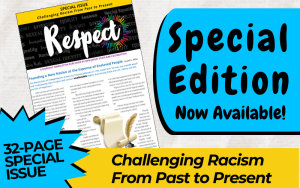
 The New Jersey State Bar Foundation has produced a special issue of Respect, its diversity and inclusion newsletter. Titled Challenging Racism From Past to Present, the 32-page special issue begins with an article on slavery and the U.S. Constitution, examining America’s founding documents through a racial lens. The remaining 11 articles and five sidebars examine other examples of institutional racism, including environmental racism, the racial wealth gap, racism in sports, and so much more.
Challenging Racism is FREE and hard copies can be ordered from our website, visit publications.njsbf.org. A PDF of Challenging Racism may also be downloaded from that page (just open the Respect toggle). NOTE: If you are a regular Respect subscriber, you will not receive copies of the special issue unless you order it. The individual articles from the special issue can be downloaded from Respect’s companion blog, The Rundown.
Here are the headlines from Challenging Racism From Past to Present:
Founding a New Nation at the Expense of Enslaved People
The Declaration of Independence, written by Thomas Jefferson in 1776, states that “all men are created equal” and “endowed by their Creator with certain unalienable Rights, that among these are Life, Liberty and the pursuit of Happiness.” At the time these words were written, more than 500,000 enslaved people were part of what would become the United States of America. READ MORE
Freedom Gives Way to Segregation
The Thirteenth Amendment to the U.S. Constitution, ratified in December 1865, abolished slavery in the United States. While the amendment indicated progress, it was also during this time period that legal segregation was ushered in as new laws were used to oppress and assert control over the formerly enslaved. Those laws would last for more than 100 years. READ MORE
Danger for African Americans When the Sun Goes Down
Instead of welcoming signs at the city limits of small-town America in the late 19th and 20th centuries, there were warnings. A sign in one Connecticut town read, “Whites Only Within City Limits After Dark.” Other signs across the country were more forceful, often using foul language and racial slurs. “[Racial slur], God Help You If the Sun Ever Sets on You Here!” was one of the more hateful examples. Towns that contained these signs were referred to as sundown towns. The wording on the signs varied in each town, but the warning was clear—no African Americans after dark. READ MORE
Citizen’s Arrest Laws Trace Origins to Slavery
Have you ever heard the phrase “I’m making a citizen’s arrest?” Citizen’s arrest laws date back to 13th century England. They were a way of helping local sheriffs enforce the law because often they couldn’t get to the crime scene for hours or even days. With law enforcement more accessible—especially with the advent of 911—it leaves many to wonder why citizen’s arrest laws still exist and point to their racist origins. READ MORE
Struggle to Protect African American Voting Rights Continues
When the first federal elections were held in the United States only white men who owned property could vote. Since then, the franchise has been expanded three times through the 15th, 19th, and 26th amendments to the U.S. Constitution. Frederick Douglass, the famous African American abolitionist, recognized the importance of having access to the ballot box. READ MORE
What Story Do Confederate Monuments Tell?
The debate over whether Confederate monuments and other testaments to the Confederacy merit a place in public spaces continues. Some believe that these monuments are simply a celebration of Southern heritage, while others see them as a sign of oppression and hate. READ MORE
Taking Affirmative Action
In 1960, a report from the U.S. Labor Department found that Black workers on average made 60% less than white workers. In 1961, President John F. Kennedy took action, issuing Executive Order 10925, which prohibited government contractors from discriminating on the basis of race. READ MORE
African Americans and the Medical Profession: A History of Distrust
Black people were 1.1 times more likely than their white counterparts to contract Covid-19, 2.8 times more likely to be hospitalized because of it, and two times more likely to die from the disease, according to Centers for Disease Control (CDC) data compiled from March 2020 through October 2021. Still, a Pew Research report released in December 2020 revealed that only 42% of Black Americans were inclined to get vaccinated, compared to 63% of the Hispanic population and 61% of whites. READ MORE
From Environmental Racism to Environmental Justice
Can the environment be racist? While the environment may not be racist, government rules and policies, put in place decades ago, have perpetuated what is known as environmental racism. The Environmental Protection Agency (EPA) defines environmental racism as “the disproportionate impact of environmental hazards on people of color. It is a form of systemic racism that occurs when corporate or government decisions intentionally disadvantage minority communities, such as by exposing them to toxic waste sites or industrial facilities.” READ MORE
Racial Wealth Gap Bars American Dream for Some
Home ownership is the pinnacle of the American dream. Owning a home provides a basis to accrue wealth and a home is an investment that can be passed down through generations. While the American dream is attainable for some, it is not a reality for everyone. That disparity has led to a racial wealth gap. READ MORE
Tackling Racism in Sports
The sports world may appear more integrated than other career paths, but Black athletes face racial inequity as well. In the aftermath of the Civil War, Black athletes thrived in some sports, but none more so than in horse racing, which is America’s oldest sport, dating back to the early 1700s. In fact, 13 of the 15 jockeys that competed in the first Kentucky Derby, held in 1875, were Black. The winning jockey that first year was Oliver Lewis, a Black man born into slavery in 1856, who rode a horse named Aristides to victory. In the Derby’s first 28 years, 15 of the winning jockeys were African American. READ MORE
The Discriminatory Consequences of America’s War on Drugs
At a press conference in 1971 President Richard M. Nixon declared that drug abuse was “public enemy number one” in the United States. “In order to fight and defeat this enemy it is necessary to wage a new all-out offensive,” President Nixon said. The militaristic theme was kept up throughout the speech. The media picked up on the war theme and the “war on drugs” was born. READ MORE
Like a Subscription?
If you would like to be notified when new issues of Respect have been published, sign up for a digital subscription. If you would like a FREE print subscription, you can subscribe using our Publication Order Form. You’ll be sent the last published issue and when new issues are printed, you’ll receive those as well. Please order as many as you need for your students.